Explicit Disclosure
This note is the definitive guide to disclose(), what it means, how the compiler tracks witness data, and the common mistakes that trigger errors.
Docs: Explicit Disclosure Examples: 07.01 disclose
Intuition First
disclose() is not a cryptographic operation. It does not encrypt, hide, or transform data. It is a compile-time annotation that tells the compiler: “I am intentionally making this data public.”
The compiler enforces this boundary. If witness data (from a witness callback) reaches the public ledger without disclose(), the compiler errors. This is the witness protection program, it prevents accidental privacy leaks.
Understanding disclose() means understanding that the compiler tracks data flow, not that there’s magic happening at runtime.
The Core Rule
A Compact program must explicitly declare its intention to disclose data that might be private before:
- Storing it in the public ledger,
ledger x = disclose(witness()) - Returning it from an exported circuit,
return disclose(witness()) - Passing it to another contract, via
sendUnshielded
Privacy is the default. disclose() is the explicit exception.
What Counts as Witness Data
Witness data originates from:
- Return values of
witnessfunction calls, The secret key, balance, etc. - Arguments passed to exported circuits, These come from the DApp, which may contain witness-derived data
- Arguments passed to the contract constructor, Same as above
Any value derived from witness data is also witness data. The taint follows the data everywhere.
The disclose() Flow
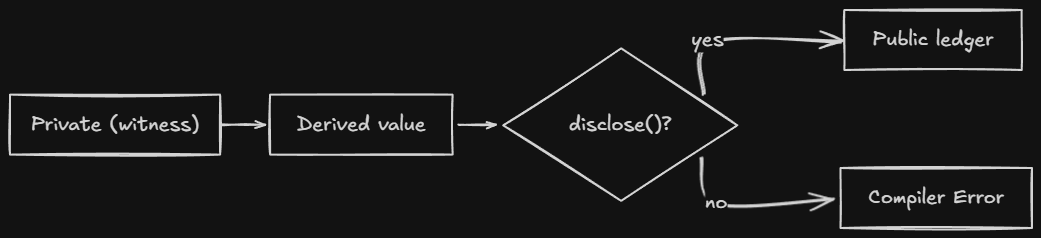
disclose() Syntax
disclose(expr)
Wraps any expression. The compiler checks if expr contains witness data, if it does, the annotation is recorded and the disclosure is permitted.
// Basic: disclose a witness value
ledger balance: Uint<64>;
export circuit record(): [] {
  balance = disclose(getBalance());
}

// Array: disclose only the private element
const result = [publicValue, disclose(privateValue)];

// Function: disclose the return value
return disclose(helper(witnessData));
Place disclose() as close to the disclosure point as possible. This minimizes the scope of what you’re declaring public.
The Compiler Error
When you forget disclose(), the compiler gives you a detailed trace:
Exception: line 6 char 11:
  potential witness-value disclosure must be declared but is not:
    witness value potentially disclosed:
      the return value of witness getBalance at line 2 char 1
    nature of the disclosure:
      ledger operation might disclose the witness value
    via this path through the program:
      the right-hand side of = at line 6 char 11
This tells you:
- Where the witness data came from (
getBalance) - Where it tried to go (the ledger)
- The exact path through the program
Indirect Disclosure
You cannot hide witness data by passing it through arithmetic or helper circuits. The compiler tracks data flow through every operation.
// Compiler catches this
circuit obfuscate(x: Field): Field {
  return x + 73;  // output is still witness data
}

export circuit record(): [] {
  const s = getBalance() as Field;
  const x = obfuscate(s);
  balance = x as Bytes<32>;  // error
}
Even x + 73 doesn’t hide the witness data. The compiler knows the output depends on the input.
Disclosure Via Return Values
Returning witness-derived data from an exported circuit is a disclosure:
// compiler error: balance flows to return
export circuit balanceExceeds(n: Uint<64>): Boolean {
  return getBalance() > n;  // comparison result depends on witness data
}

// correct: declared disclosure
export circuit balanceExceeds(n: Uint<64>): Boolean {
  return disclose(getBalance()) > n;
}
Even a comparison result counts. If the output can be determined by witness data, it’s a disclosure.
Where to Place disclose()
Place it as close to the disclosure point as possible:
// Wrong: declares more than necessary
export circuit process(data: PrivateData): [] {
  const result = compute(disclose(data));  // too early
  ledger = result;
}

// Right: declares only what's needed
export circuit process(data: PrivateData): [] {
  const result = compute(data);
  ledger = disclose(result);  // only the final output
}
The earlier you disclose, the more you declare public. Wait until the last possible moment.
Standard Library Exceptions
Some functions handle witness data without explicit disclosure:
| Function | Witness-tainted? | Why |
|---|---|---|
transientCommit(e) | No | Random nonce provides sufficient hiding |
transientHash(e) | Yes | Bare hash may not hide input |
// no disclose() needed: transientCommit's nonce hides the value
ledger commitment: Field;
export circuit commit(v: Field): [] {
  const nonce = freshNonce();
  commitment = transientCommit(v, nonce);  // ok
}

// disclose() needed: transientHash doesn't hide
ledger hashed: Field;
export circuit storeHash(v: Field): [] {
  hashed = disclose(transientHash(v));  // required
}
The nonce in transientCommit provides enough randomness that even someone who knows the value can’t determine the commitment without the nonce.
The Two-World Model, Revisited
┌─────────────────────────────────────────────────────────────┐
│                    PRIVATE WORLD                           │
│                                                             │
│  witness getBalance(): Uint<64>;                          │
│  returns: 1000  (never on chain)                        │
│                                                             │
└─────────────────────────────────────────────────────────────┘
                            │
                            ▼ (disclose())
                            │
┌─────────────────────────────────────────────────────────────┐
│                    PUBLIC WORLD                          │
│                                                             │
│  export ledger balance: Uint<64>;                        │
│  balance = disclose(getBalance());                       │
│  stored: 1000  (public, declared)                    │
│                                                             │
└─────────────────────────────────────────────────────────────┘
Without disclose(), the compiler draws this line and prevents crossing.
Common Mistakes
-
Thinking
disclose()encrypts. It doesn’t. It’s a compile-time annotation. There’s no runtime cost and no cryptographic transformation. If you disclose something, it’s public. -
Forgetting indirect disclosure. Passing witness data through
obfuscate(x) = x + 73doesn’t hide it. The compiler tracks data flow through every operation. -
Not disclosing comparison results.
return getBalance() > nis a disclosure, the comparison reveals information about the balance. Usedisclose(). -
Disclosing too early. Placing
disclose()at the start of a function declares everything derived from that value as public. Place it at the last possible moment. -
Assuming
transientHashhides witness data. It doesn’t. UsetransientCommitif you need hiding without disclosure. Or usedisclose(transientHash(...)).
Comparison Layer
| Concept | Solidity | TypeScript | Compact |
|---|---|---|---|
| Private data | private (still on chain) | private fields | witness |
| Privacy mechanism | encryption (optional) | memory isolation | ZK proofs |
| Disclosure | explicit in code | code logic | disclose() annotation |
| Enforcement | contract code | convention | compiler |
The key difference: in Solidity, privacy is a convention. In Compact, it’s enforced by the compiler.
Quick Reference
| Scenario | Require disclose()? |
|---|---|
| Store witness value in ledger | Yes |
| Return witness value from exported circuit | Yes |
| Return comparison result | Yes |
| Use witness data inside a circuit (no ledger access) | No |
Store transientCommit(witnessValue) in ledger | No (nonce hides) |
Store transientHash(witnessValue) in ledger | Yes |
Store persistentCommit(witnessValue) in ledger | No (nonce hides) |
Store persistentHash(witnessValue) in ledger | Yes |
Cross-Links
- Previous: Witnesses Private input mechanism
- Next: Data Types Type system
- See also: Ledger State The two-world model
- See also: Standard Library Hash functions
- Examples: 07.01 disclose